Medical devices and optical components always have extremely strict requirements for the production environment. Cleanrooms largely satisfy the production requirements of cleanliness and sterility. This article provides a detailed explanation of cleanroom injection molding and some essential operating systems and application industries. If your products require cleanroom assistance, this article can provide you with excellent help.
Understanding Clean Room Injection Molding
Cleanroom injection molding involves placing precision injection molded parts in a dynamically controlled cleanroom environment for production. Cleanrooms can guarantee that every part produced has extremely high cleanliness and consistency through technical and management measures. It is usually applied to the strict requirements of industries such as medical injection molding and electronics. It is a systems engineering that integrates a controlled environment, special processes, strict management and comprehensive verification.
Basic Classification of Cleanrooms
ISO is an international standardization organization consisting of multiple organizations from different countries. They jointly formulated standards of international validity. At present, the cleanroom grade that most widely adopts international standards globally is ISO 14644-1. Although the old US federal standard 209E has been abolished, the Class term is still used in production within the industry.
ISO Class is based on the airborne particle concentration in the air. In other words, the class is defined by the maximum number of particles of a specific size that are ultimately allowed per square meter. Particles of ≥0.5 micrometers and ≥5.0 micrometers are usually monitored. The cleanliness classes can be divided into nine levels from high to low.Most parts formed in injection molding occur in ISO Class 7 and ISO Class 8 clean rooms.
For the vast majority of injection molding applications, ISO 7 and ISO 8 are the most common and cost-effective choices. To have a clear positioning of the project, it is crucial to understand the differences between ISO 7 and ISO 8.
| ISO Class | Maximum number of particles per cubic meter of air (≥0.5µm) | Maximum number of particles per cubic meter of air (≥1.0µm) | Maximum number of particles per cubic meter of air (≥5.0µm) | Application |
| ISO 7 | 352,000 | 83,200 | 2,930 | Mainstream cleanroom. The core production and assembly areas for the vast majority of sterile medical devices and critical drug packaging. |
| ISO 8 | 3,520,000 | 832,000 | 29,300 | Basic cleanroom. It is commonly used as the background environment of clean workshops, or for the production and packaging of in vitro diagnostic consumables, non-sterile medical devices, and electronic components with slightly lower requirements. |
ISO7 Cleanrooms for Injection Molding
The ISO 7 cleanroom is a closed injection molding area. It has a stronger sense of air flow. It usually requires 30 to 60 times air changes per hour or even more. Therefore, the airflow in the clean room will be stronger and the purification speed will be faster.
ISO 7 is mainly applied to sterile medical devices, which come into direct or indirect contact with the human circulatory system and sterile tissues, such as syringes, implant components, and parts of surgical tools.High-demand electronic and optical components can also be produced in ISO 7 cleanrooms.
ISO8 Cleanrooms for Injection Molding
ISO 8 takes about 10 to 25 times per hour of ventilation rate. Its standard is more lenient than ISO 7. It is usually used to produce products that do not directly enter the human bloodstream or sterile parts, such as sample cups, reagent kit shells, etc. It can also produce consumer electronics and industrial electronic components that do not have particularly high requirements. The final packaging of the product also needs to be carried out in an ISO 8 cleanroom.
It should be noted that a production workshop can be of ISO Class 8 as a whole, or laminar flow hood can be installed above key production processes to achieve ISO 5 grade internally. This production process is highly cost-effective.
ISO 13485: ISO 13485 is a quality management system standard for medical devices, and ISO 14644 is a production environment standard. A qualified medical device supplier must simultaneously meet two conditions: a cleanroom that meets the Class requirements and an effective quality system in operation.
Environmental Control Systems
Airflow Systems
The purpose of the air flow system in a cleanroom is to efficiently filter out clean air and deliver it to the working area, allowing it to effectively dilute and carry away the contaminants generated during the working process. The airflow in a cleanroom can be classified into laminar flow, non-unidirectional flow and mixed flow.
Laminar Air-flow
Laminar flow is the air that flows through the entire cleanroom in a single direction along parallel streamlines through HEPA filters. It can directly and quickly sweep the particles emitted by the equipment to the return air outlet, preventing diffusion and cleanroom contamination. And it can also form a clean air barrier for the products and key process procedures.
In ISO 7 or ISO 8 injection molding workshops, laminar flow is typically used in areas with high local cleanliness requirements, such as above the mold outlet of an injection molding machine, above the conveyor belt for automated part removal, or on the workbench for final product packaging.This is also known as a laminar flow hood. It can create an ISO 5 ultra-clean space in an ISO 8 cleanroom and is an efficient and economical solution.
Non-unidirectional Airflow
Non-unidirectional airflow can also be called turbulence flow. Its airflow direction is complex and changeable. Non-unidirectional airflow mixes clean air with indoor air and randomly removes particles through the filter, thereby gradually reducing the concentration of pollutants throughout the room.
Non-unidirectional flow is the most commonly used and standard airflow pattern in ISO Class 6, Class 7 and Class 8 cleanrooms. The injection molding workshop with non-unidirectional flow design not only guarantees overall cleanliness but also offers more flexible equipment layout and personnel activities.
Besides, the air changes per hour is the core of a non-unidirectional airflow system. The higher the air changes per hour, the greater the ability of the clean room to dilute the air and remove pollutants, and the energy consumption will also increase accordingly.
Filtration Systems
The filtration system is the key to clean air quality and is mainly responsible for removing particles from the airflow. The filtration system is a hierarchical and progressive system, including primary filters, intermediate filters, high-efficiency particulate air filters(HEPA) and ultra-low penetration air filters(ULPA).
HEPA Filter
HEPA filters are composed of countless randomly arranged glass fiber papers folded to form the filter material, and then capture particles through interception, impact, diffusion and classical effects. It is the core terminal filter for achieving ISO Class 5, Class 6, Class 7 and Class 8 cleanliness levels.It can filter various airborne particle concentration and dust of 0.3 µm with an efficiency of 99.97%. 0.3 µm is also the most penetrating particle size.
ULPA Filter
ULPA is a kind of high efficiency filter, its filtration capacity is much better than HEPA. It can remove particles of 0.12 microns and above with a filtration efficiency of no less than 99.999%.
It is typically used in ISO 3, ISO 4 and some ISO 5 cleanrooms where there are extreme requirements for ultrafine particles, such as semiconductor wafer manufacturing, implant assembly, semiconductor packaging, etc. In the injection molding industry, it is only used in the most advanced applications, such as precision semiconductor carriers.
Positive and Negative Pressure Airflow
The positive and negative pressure airflow mainly regulates the difference between the air volume delivered into the room and the air volume discharged from the room, so that the room produces a stable pressure difference with respect to the reference area.
Pressure control determines the direction of air flow, which is also an effective means to prevent the cross-spread of pollution.
Positive Pressure Airflow
Positive pressure refers to the pressure inside a clean room being higher than the adjacent external areas. When the door of the cleanroom is opened, the clean air inside the cleanroom will flow out, effectively preventing unfiltered and dirty air from the outside from entering the room.
Including the injection molding industry, almost all production clean rooms will use positive pressure design. If there are multiple clean-level rooms connected in series, the manufacturer will set a pressure gradient for the clean rooms. The pressure increases step by step, always guaranteeing that the airflow flows from the area with the highest cleanliness to the area with the lowest cleanliness.
Negative Pressure Airflow
Negative pressure refers to the pressure inside a clean room being lower than the adjacent external areas. When the door is opened, external air is drawn into the room, thus trapping harmful substances inside and preventing them from polluting the external environment.
Negative pressure airflow is less applied in the injection molding industry. It may be adopted in some special processes involving a large amount of dust or harmful volatile substances, such as material grinding and post-treatment after spraying. It is usually used in biosafety laboratories, hospital isolation wards and process areas in the pharmaceutical industry.
Cleanroom Injection Molding Requirements
Loading System
Any component entering the clean room needs to pass through a negative pressurization chamber to remove dust, particles from the components. The negative pressurization chamber can guarantee that any behavior crossing the barrier is under control. Standardized loading and unloading can stably keep the temperature, humidity, pressure difference and cleanliness level set in the cleanroom.
The system is not only responsible for material loading and unloading, but also for the transfer of finished products or semi-finished products between different processes, as well as the removal of waste and substandard products. A good loading system not only controls the contamination in the clean room but also improves the efficiency of material flow and guarantees production safety.
Feeding system
Cleanroom injection molding production typically employs a central centralized feeding system. The feeding system is connected to the storage silo in the workshop through a closed pipeline. The materials are precisely conveyed to the drying hoppers of each injection molding machine through vacuum feeders or pressure conveyors. The entire process is automatically completed by the central control system, reducing human intervention.
Material Drying Equipment
The vast majority of engineering plastics are hygroscopic. When moisture vaporizes at high temperatures during injection molding, it can become a source of contamination and lead to defects such as bubbles and reduced strength in the products. The dryer can perform deep dehumidification and remove moisture.
The dryer is a fully closed loop.It is usually placed outside without exchange with clean room air to avoid introducing particles and microorganisms into the raw material. The drying equipment is connected to the feeding equipment to better convey raw materials.
Cooler System/Chiller
The cooling device mainly provides cooling water for the injection molding machine. The cooling device is mainly installed on the outside of the clean room to prevent the algae and bacteria that grow from the evaporation of water vapor from contaminating the clean room.
The circulating water from the external cooling tower and the circulating water used by the equipment in the clean room will be systematically isolated. Two completely independent circulation systems can effectively prevent cross-contamination.
Electric Injection Molding Machines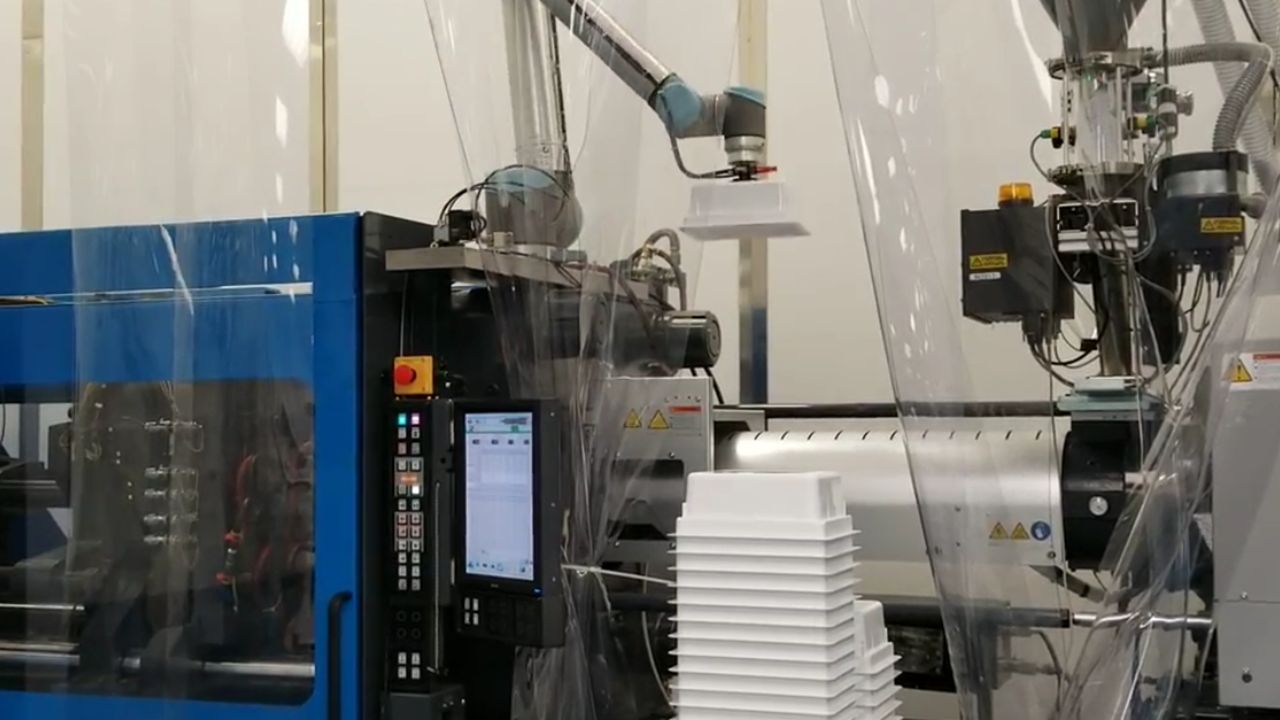
Electric injection molding machines operate on the same principle as ordinary injection molding machines, but all their components have been optimized to meet the requirements of clean rooms. Compared with hydraulic injection molding machines, electric injection molding machines don’t use hydraulic oil, completely eliminating the risk of hydraulic oil leakage contaminating molds, products and clean rooms.
Post-molding Operations
Automated Part Removal
Automated part removal completely avoids manual contact with products and eliminates the biggest contamination sources of human skin flakes, oils and sweat. The equipment can also achieve high-precision and stable consistency in item removal, preventing products from dropping or being scratched.
Cleaning Equipment
Product cleaning mainly uses ionic air, which can remove static electricity from the product surface and blow away particles that are not firmly attached. If the product has higher cleaning requirements, it will be placed in an ultrasonic cleaner specifically designed for clean rooms. The cleaning equipment mainly removes trace contaminants that may adhere to the products during the molding and interval processes.
Packaging Restrictions
Product packaging operations must be carried out in the high-cleanliness area of the clean room. The product needs to use packaging materials that have been strictly sterilized and cleaned. Some materials that are prone to precipitation and shedding may produce particulate matter and cause contamination, such as plastic packaging and coated cardboard. These materials are prohibited from being used inside clean rooms.
Quality Control
Cleanroom injection molding involves cleanroom performance testing as well as product and process related testing.
Comprehensive environmental testing of cleanrooms includes airborne particle concentration counting, microbial testing, and physical parameter testing, such as pressure difference, temperature and humidity, air velocity, and air change rate between the cleanroom and the outside.
Product and process-related testing includes product cleanliness testing, process water quality monitoring, and online process monitoring for injection molding. The product cleanliness test mainly examines whether the cleanliness of the product itself meets your specification requirements. Regularly test the microbial limits and other indicators of cooling water and cleaning water to guarantee that they do not become sources of pollution.
Cleanroom Injection Molding Applications
Medical and Pharmaceutical Industry
For high-risk implantable devices of Class III or II, these usually require a production environment of ISO Class 7 or above, and strict compliance with GMP(Goods Manufacturing Practice) and ISO 13485 standards is necessary. For example, the pacemaker can, orthopedic implants, subcutaneous injection ports, etc.
Sterile medical devices are usually produced at ISO Class 7 or below and undergo final sterilization. For example, syringes, cell culture dishes, etc.
For the packaging of the following drugs, cleanrooms usually need to meet ISO Class 7 or higher standards and verify that the drug packaging itself does not become a source of pollution.
Semiconductor and Electronics Industry
The semiconductor and electronics industry is extremely sensitive to micro-particles and static electricity. The control of particulate matter presence is a challenge in semiconductor production.
Even tiny particles can cause contamination of equipment.Its cleanliness requirements are approximately between ISO Class 6 and ISO Class 3, and it needs to be superimposed with strict ESD protection and molecular-level cleanliness. Higher-level cleanrooms are mainly used to prevent circuit short circuits, signal interference and damage to precision components.
Biotechnology
The production process of biological experimental equipment is subject to strict supervision. Cleanroom injection molding technology can guarantee the high quality and safety of products.
The cleanroom grade requirements range from ISO Class 8 to ISO Class 5. The cleanroom mainly controls the microbial limit, prevents microbial contamination and cross-contamination, keeps the purity of samples and ensures the sterility of the production process. The products produced include bioreactors, laboratory liquid handling components, etc.
Food and Beverage Industry
The food industry requires real-time and strict production processes and strict compliance with safety regulations for food manufacturing. Food and beverage companies should use non-polluting molds to avoid the possibility of causing contamination or posing a threat to food safety.
The food industry needs to create a closed and sterile environment, and each production process must be strictly regulated. Cleanroom injection molding undoubtedly provides excellent conditions for aseptic production.
Optics and Optoelectronics Industry
The optical industry typically requires cleanrooms of ISO 6 or even higher. The entire production process strictly controls airborne particle concentration in the air. The optical industry typically pursues the ultimate light transmittance and defect-free performance. Any dust that lands on the lens will form a black spot on the image.
Besides, any particles on the lidar sensor will cause contamination and also interfere with the laser path. The pollution of AR glasses can also directly affect visual clarity and the user experience. Therefore, the manufacturing process of optical components needs to avoid scratches and the adhesion of fine dust.
Risk Management for Cleanrooms Injection Molding
Personnel Guidelines
The operator’s headgear must completely cover all the hair, beard and sideburns.
Masks need to cover the mouth and nose to reduce droplets and particles produced by breathing.
Wear anti-shedding and anti-static one-piece clean suits, and use clean room-specific shoes or shoe covers.
Operators also need to wear gloves and change gloves when necessary according to the production process to prevent cross-contamination.
Operators are prohibited from wearing makeup, spraying perfume, or wearing jewelry. They are also forbidden to bring in personal items such as paper and mobile phones without approval.
Operators must operate the equipment with dedicated tools or wearing gloves. Unless necessary, it is strictly prohibited to touch the product, mold surface or critical parts of the machine with bare hands.
When personnel have colds, skin diseases or other conditions, they should suspend entering the high-cleanliness area.
ESD Protection
Especially in the production of electronic components, static electricity can attract particles in the air and contaminate the products, which may directly break down or damage the precision circuits.
Therefore, most manufacturers will install grounding systems in clean rooms to conduct away static charges. For example, measures such as laying anti-static floors, grounding workbenches and equipment, or having personnel wear anti-static wrist straps.
It is also possible to install an ionizer above the critical station to eliminate the charge on the insulator.Ionizer needs to be regularly inspected and calibrated to guarantee that their balance and decay time meet the standards.
Procedure Document
The qualifications, agreements and maintenance of cleanrooms are all very comprehensive. Cleanroom injection molding manufacturers should strictly abide by the cleanroom establishment standards. To this end, it is necessary to establish a documented and process-oriented management system.
The process documents should establish standard operating procedures for each operation and set scientific internal control standards for all detection data. The document should also clearly define the warning limits and action limits of the process.
The file also needs to monitor and record all the details of the product production cycle, the entire testing process, and the cleaning and maintenance of the clean room to achieve complete traceability.
Cleaning and Maintenance
Cleanrooms need to be kept through strict and standardized cleaning procedures. The cleaning of the interior of a clean room is divided into daily cleaning and periodic cleaning. Cleaning tools require the use of dedicated cleaning agents, low-pollution mops and dedicated cleaning carts.
The cleaning tools in each cleanroom should be clearly marked for individual use. Tools need to be stored in clean cabinets and designated areas to prevent secondary contamination.
Regular microbial sampling should be conducted on the key surfaces after cleaning to check whether the cleaning effect meets the standards. And keep a record of the cleaning process on file, including the person in charge, the time, the batch number of the cleaning agent to facilitate subsequent inquiries and traceability.
FAQ
How to determine which level of cleanroom is needed for the products?
When considering which cleanroom class your product requires, you can determine it based on industry standards, product usage, and the final requirements of the product. For instance, conventional implantable or sterile products usually require ISO Class 7 or even higher. Precision electronic components require ISO 5 or ISO 6. When customizing products, you can consult experienced cleanroom injection molding suppliers, who will assist you in professional assessment and solution formulation.
How can mold design meet the requirements of cleanliness?
The design of molds usually adopts corrosion-resistant stainless steel to avoid the formation of particles. The key areas of the mold need to achieve high mirror finish to reduce the adhesion and residue of particles. The mold is connected to the vacuum pump for active exhaust. Automated item removal should reduce wear and tear. The design of the mold should facilitate thorough cleaning and maintenance. These measures can prevent the mold from becoming a contamination source.
How to test and prove that the cleanliness of the product meets the production specifications?
To test and prove that the cleanliness of the product complies with the standards, it is necessary to conduct objective and quantifiable detection methods and form documented reports. Detects the particulate contamination, microbial quantity and chemical residues of the products.
The test report needs to clearly list the test results and compare them within the limits of industry standards to clearly determine whether they are qualified. The test data should guarantee that there are complete records of the samples, the test environment and other variations to achieve full traceability throughout the process.
If customizing silicone injection molded products, how can the process avoid generating particles?
To avoid the generation of particles in the process, efforts should be made from several aspects, including raw materials, molds, process control and environmental management. Raw materials should be kept in a clean packaging and storage environment. The core of mold design lies in smoothness, airtightness, low wear and easy cleaning. The time, temperature, pressure and speed of the process should all be precisely controlled. Besides, it is also necessary to clean the equipment and the clean room regularly.
How to prevent secondary pollution when trimming burrs or flash?
The most fundamental solution is to minimize flash generation from the source by optimizing injection molding parameters and mold precision. Moreover, measures such as setting up dedicated isolation areas or directly using vacuum nozzles to collect debris at the source after trimming can also be taken to prevent particle diffusion.
Final Thought
Legensilico is a manufacturer specializing in the production of silicone products. For high-specification silicone products for medical and food use, Legensilico adopts the production requirements of high-standard cleanroom injection molding to meet the needs of customers. If you have any needs for custom silicone products, please feel free to contact us.